
Turning Passive Income Into Passive Wealth
The monthly distribution hits your account. Most investors move it to checking. The ones quietly building wealth put it back.
That's the whole game. Not a different investment, not a better market — just a different instruction for what happens to the income your money already generates. Charles Schwab describes the effect as a snowball: reinvested dividends buy more shares, which generate more dividends, which buy more shares. Over time, that snowball gets harder to stop.
Collecting vs. Building Dividends
When dividends are reinvested automatically, the investment runs itself — no new decisions, no transfers, no timing. The position grows because it's designed to grow. According to Hartford Funds, drawing on Morningstar data, reinvested dividends and the power of compounding accounted for 85% of the cumulative total return of the S&P 500 Index going back to 1960, and averaged roughly a third of total return on a decade-by-decade basis. The contribution varies by period, but the pattern is consistent: over long time horizons, what you do with dividends shapes outcomes more than most investors expect.
How It Works
The mechanism is straightforward. Instead of withdrawing that income, it's directed to buy more shares — and those additional shares pay income too. Over time, you're not just earning a return on your original investment; you're earning a return on every reinvested dividend that came before it. A modest yield reinvested faithfully will typically outperform a higher yield that gets spent. Starting early matters more than starting big: an investor who begins with a small amount and reinvests consistently will, over a long enough horizon, outperform one who waits until they have more to invest.
The barrier usually isn't disagreement. Most investors skip reinvestment because a small monthly distribution doesn't feel like it moves the needle. But it does — because each reinvested dividend buys more shares, those shares generate more dividends the following month, and the cycle builds on itself quietly and continuously.
Here's an example:
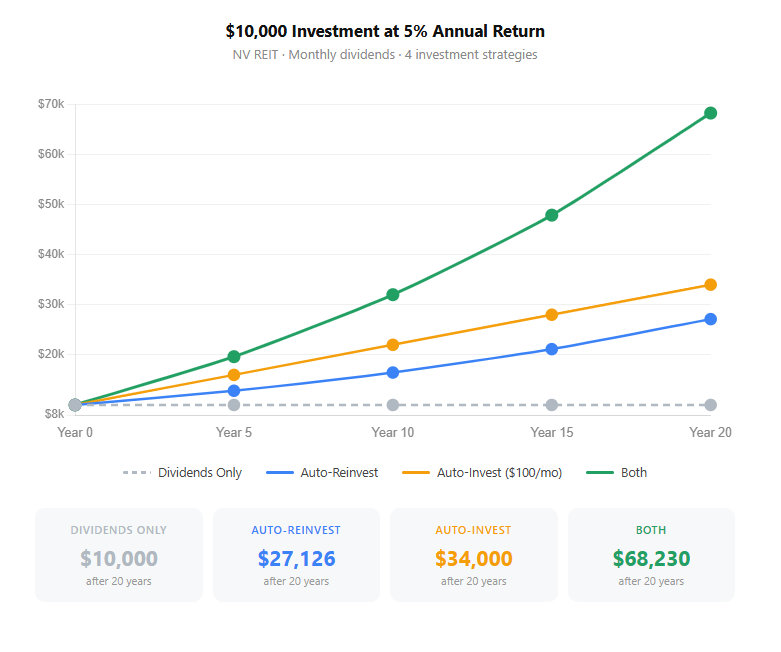
The projections are based on a $10,000 starting balance, a 5% annual return distributed as monthly dividends, and — where noted — $100 per month in additional contributions. These are hypothetical illustrations; actual returns may vary.
Build Your Wealth
Investors with dividend-paying positions in the NV REIT generally approach their distributions in one of three ways — each with a different goal for long-term growth. The right choice depends on where the investor is financially and what they need the income to do.
Dividends Only. Monthly distributions are paid directly to you, principal unchanged. Predictable, consistent income — the right choice if that cash flow serves a purpose in your life right now.
Auto-Reinvest. Dividends are automatically used to purchase additional shares, so your income starts generating its own income. Over 20 years, a $10,000 initial investment grows to roughly 2.7x its starting value — without a single additional dollar contributed.
Auto-Invest. Each month, a fixed contribution of your choosing is automatically invested to purchase additional shares, separate from any dividends earned. Your position grows steadily through consistent contributions, and the growing base generates increasing distributions over time.
What Our Investors Do
The investors getting the most out of the NV REIT run both at once — auto-reinvest stacking on top of auto-invest. Dividends go back in. Monthly contributions go back in. The base grows from two directions at the same time, and the compounding effect compounds.
On a $10,000 starting investment with $100 a month added at a 5% annual return: by year 5, the position has grown to nearly double the initial investment. By year 10, more than 3x. By year 15, nearly 5x — driven not by outsized returns, but by two consistent habits working together over time.
No market calls. No strategy shifts. Just consistency and time.
The Bigger Picture
For Neighborhood Ventures, this is the principle behind how the NV REIT is structured. Monthly distributions, automatic reinvestment, and a low entry point are all designed to give investors access to the compounding curve with as few barriers as possible. Schwab calls it a snowball. We built the NV REIT for the investor who wants to build a snowman.
About the author
Neighborhood Ventures